Research
After a coma, it is often hard to tell what state of consciousness a patient is in. Using artificial intelligence, I look for the cues that standard clinical examination misses.
- 01
Refining behavioural assessment with artificial intelligence
Patients in a coma or with a disorder of consciousness show subtle, sporadic and often noisy movements. I develop and adapt computer vision tools to these patients to extract hundreds of fine behavioural features: facial landmarks, skeleton, head movements, gaze, facial action units. Machine learning methods, combined with state-of-the-art explainability techniques, then process these large amounts of data and bring out the behavioural cues that matter most during recovery, for diagnosis as well as prognosis.
 02
Uncovering the basis of caregivers’ intuition
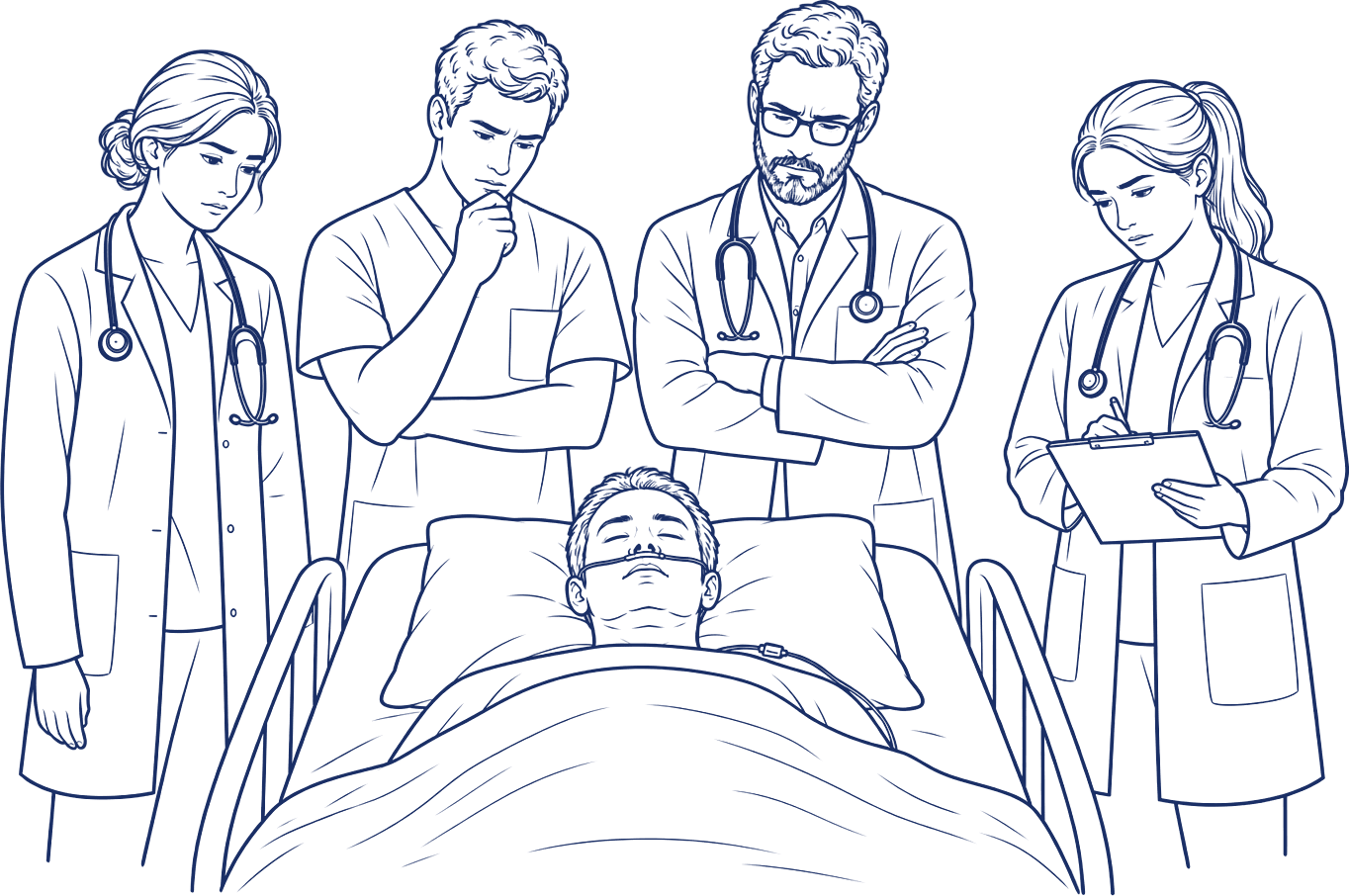
In intensive care, caregivers form an intuitive impression of their patients’ state, and this intuition turns out to be as accurate as the reference diagnostic tool. Using the tools I develop, I try to identify the behavioural cues it relies on, to help clinical teams better understand and manage their patients.
- 03
Understanding brain–behaviour dissociations
In about a third of patients with disorders of consciousness, brain activity is preserved while behaviour remains unresponsive. To understand why these dissociations arise and what role they play in recovery, I synchronise brain activity and behaviour with fine temporal precision, and follow them longitudinally throughout recovery.
- 04
Studying the coupling between body, brain and environment
I study how far the re-emergence of consciousness may stem from a coupling between body, brain and environment. I record brain activity (EEG), cardiac activity (ECG) and behaviour (video) simultaneously, while varying the environment with emotional and autobiographical stimulation. I then develop statistical and machine learning methods to analyse the interactions between all these signals across different states of consciousness.
Setting
This work is carried out in the CAP team (Communication, Auditory Perception, Pathologies and Disorders) of the Lyon Neuroscience Research Center (CNRS UMR 5292, Inserm U1028, Université Claude Bernard Lyon 1), with support from the Fondation des Gueules Cassées.